


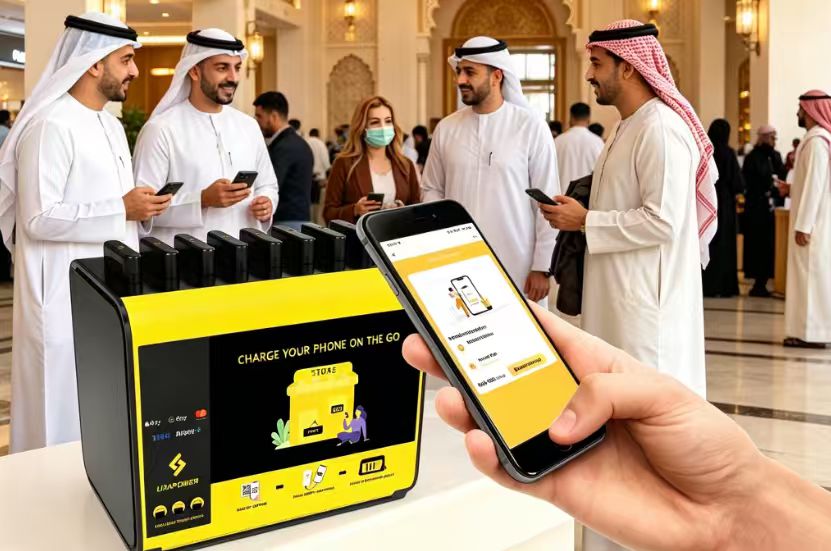
Dubai is a well-known international tourism and trade hub in the Middle East region of Asia. With a highly digitalized environment and a concentration of high-end consumers, the city attracts continuous traffic all year round. The extreme heat accelerates mobile battery consumption, while public charging facilities remain limited. This creates strong and stable demand for charging solutions.
Currently, the shared power bank market in Dubai is still in a “blue ocean” stage, featuring low competition and high average spending per user. Understanding the market conditions, profit model, and implementation strategy in Dubai presents a valuable opportunity for overseas entrepreneurs.
I. Shared Power Bank Market in Dubai
1. Market Overview
Dubai has near-universal internet and smartphone penetration. Residents, business travelers, and international tourists rely heavily on mobile devices for work, shopping, and entertainment, resulting in high battery consumption.
Additionally, the city’s year-round hot climate significantly accelerates battery drain, increasing user anxiety about battery life.
As a global tourism destination, Dubai hosts numerous iconic attractions, luxury shopping districts, and hotel clusters with consistent visitor flow. However, charging infrastructure is still limited in many high-end locations, and the coverage of shared power bank services remains low. This leaves significant untapped market potential.
2. Profit Model
The revenue model for shared power banks in Dubai is clear and diversified, well-suited to a high-consumption market.
The primary income comes from time-based rental fees. With tourists and high-end consumers willing to pay premium prices, base revenue remains stable.
In addition, advertising on devices, in-app pop-ups, and partnerships with local businesses generate continuous passive income. Value-added services such as memberships, accessory sales, and enterprise rental solutions further expand revenue streams, making the overall profitability highly attractive.
3. Payback Period
Shared power banks in Dubai represent a typical light-asset business model. Initial investment mainly involves equipment purchase and location deployment, with minimal labor and maintenance costs.
Thanks to high spending power and frequent usage, devices placed in premium locations achieve high utilization rates.
Under normal operating conditions, the investment can typically be recovered within 3–4 months, after which only minimal maintenance is required, ensuring strong long-term profitability.
II. How to Operate Shared Power Banks in Asia?
.jpg)
As a leading manufacturer in the shared power bank industry, Litapower has rapidly expanded into overseas markets and secured a strong position globally.
With a complete hardware and software ecosystem, stable product quality, and mature international operations, Litapower adapts quickly to local payment systems and consumer habits. It enables large-scale deployment across multiple scenarios, helping businesses successfully establish operations in Dubai.
1. Hardware Solutions
Litapower offers a full range of devices suitable for various deployment scenarios in Dubai:
- 4, 8, and 12-slot stackable units: compact and stylish, ideal for boutique stores, trendy restaurants, cafés, and small venues
- Standard cabinet units: suitable for mid-sized restaurants, lounges, and retail shops
- 12 and 24-slot large-capacity standing units: high capacity and fast turnover, ideal for shopping malls, tourist attractions, and international airports
2. Software Solutions
- Supports Arabic and English language switching, catering to both local residents and international tourists
- Customizable software including dedicated apps, mini-programs, and backend systems
- Real-time monitoring of device status, orders, and revenue data
- Enables refined management and efficient long-term operations
 Company and Product Information Download
.jpg)

.jpg)

.jpg)
.jpg)
.jpg)


