


Egypt has abundant tourism resources and receives a large number of international tourists every year. With a large young population, the country has strong demand for offline charging services. According to statistics, Egypt received approximately 19 million international tourists in 2025, while the number increased by 21% year-on-year in 2026. The tourism industry continues to grow rapidly. Combined with the limited number and low coverage of shared charging devices in the local market, shared power bank projects in Egypt are becoming one of the new profitable business opportunities.
_metool.jpg)
I. Egypt Shared Power Bank: Market Development and Localized Deployment
Tourism and commercial cities in Egypt, such as Cairo, Alexandria, Luxor, Hurghada, and Sharm El Sheikh, offer suitable conditions for shared power bank deployment. Airports, hotels, shopping malls, tourist attractions, restaurants and entertainment venues, and major events can all become suitable deployment scenarios. In particular, tourist destinations with high visitor density have a mature payment environment and strong charging demand, which is favorable for creating continuous demand for charging services.
Localized requirements:
To achieve localized deployment of shared power banks, projects need to consider integrating local Egyptian payment systems such as Vodafone Cash, Orange Cash, Etisalat Cash, and Meeza, while also supporting international payment methods including Visa, Mastercard, and Apple Pay. For local venues, operators can cooperate with agents and channel partners through revenue-sharing models to quickly secure key locations. Pricing should be dynamically adjusted according to local consumption levels, venue costs, and equipment utilization rates. At the same time, attention should be paid to compliance requirements related to local company entities, payment services, and product certifications.
Stable profit strategies:
(1) Deployment volume
Many shared power bank projects in Egypt fail during operation mainly because the deployment scale is insufficient and regional coverage is weak, making it difficult for the brand to open up the market. Combined with the cost of sharing revenue with operations teams, a sufficient deployment scale is necessary to increase the potential profit space.

(2) Location deployment
Cooperate with strong local Egyptian agents, channel partners, and other partners to secure high-quality locations. Suitable scenarios can include chain bars, nightclubs, commercial districts, transportation hubs, tourist attractions, and hotels.
(3) Team collaboration
Having local partners and a local company can support localized project operations. Brand promotion can be carried out through social media videos, influencer endorsements, advertising posters, and other channels. In terms of operations and management, operators should develop pricing strategies, membership programs, advertising revenue models, backend data analysis, and location optimization.
II. Recommended Shared Power Bank Manufacturer in Egypt
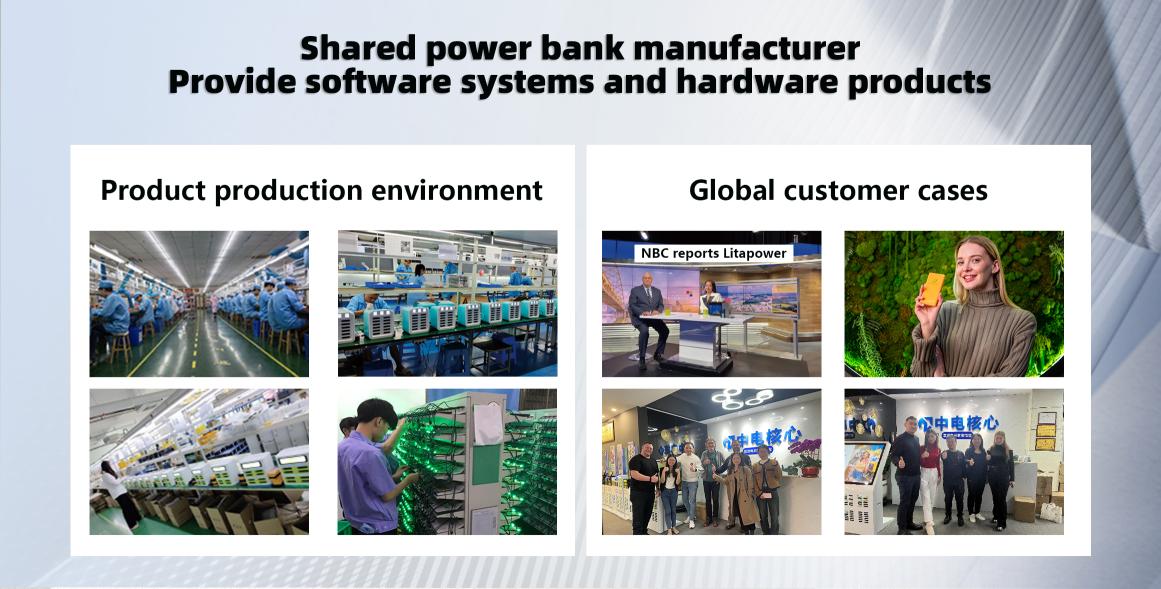
Choosing a reliable partner can help efficiently complete payment integration, compliance procedures, and brand customization for shared power bank projects in Egypt.
Litapower, the overseas brand of Zhongdian Core’s shared power bank factory, has deep experience in the Middle East market. It provides partners with OEM and private-label customization services for shared power banks, as well as software and hardware solutions, pricing standards, and operations management training, helping partners quickly build their own branded market.
Based on the actual needs of overseas customers, we provide partners with full-process support from project implementation to operational development through a “Five-Chain Service System”:
-
Supply Chain: Covers product selection, production, delivery, logistics, and after-sales service to ensure stable project supply.
-
Operations Chain: Provides support for pricing, training, and location expansion to help projects launch quickly.
-
Compliance Chain: Provides qualification, certification, and compliance support to reduce operational risks.
-
Service Chain: Expands advertising, membership, marketing, and other services to explore additional project value.
-
Capital Chain: Provides comprehensive project settlement support to ensure standardized and efficient fund circulation.
 Company and Product Information Download
.jpg)

.jpg)

.jpg)
.jpg)
.jpg)


